
Ag and Rural Caucus for August
Link to recording: https://us02web.zoom.us/rec/share/XIqx_qc0z4vhIT12aS-oDXPPYfDuX_rC9Bu1-3sbDsodKMZTCiz9UwuseWI4NcFw.u1z76oc8DrrQYU_H
Policy Briefing
6:30 pm Thursday 21 August
Jenna Friebel, ED, Skagit County Drainage and Irrigation Districts Consortium
Floodgates, Farmland, and Salmon – what are the facts?
https://us02web.zoom.us/j/85907982157?pwd=MU4vV3E3VGZ5VU02dnhvZjg2b3hK.Zz09
Click link or Paste link into browser.
Jenna alerted me to a Skagit River issue that at first glance is unrelated. She reminds me, though, that land use issues in the Skagit basin seldom stand alone.
I will take you on another travelogue. If you have travelled the North Cascades Pass you will have followed the Skagit River. And – travelling west to east – just before you start the steep climb to Rainy Pass you will note beautiful Ross Lake tucked into a valley off to your left.
Ross Lake is backed up by Seattle City Light’s Ross Dam. Less spectacular are the waters backed up by Seattle City Light’s Gorge and Diablo dams, just down stream. You will have noticed the power lines as you came up the Skagit Valley and maybe have spied the dams as well (although the Skagit is diverted through a tunnel between Diablo and Gorge dams, leaving only a dribble on the surface between them).
Seattle City Light’s dams on the Skagit are a big deal. They supply about 20 percent of its power which, of course, is the power that keeps the lights on in Seattle. And they are a big deal because of a decades-long dispute over whether City Light’s closing off the Skagit at the Gorge Dam actually interrupted fish passage.
Today’s issue, though, is City Light’s 50-year relicensing it needs from FERC (Federal Energy Regulatory Commission). City Light concedes that it would look better to FERC if City Light did something to help the fish. Fish passage through to Ross Lake may not be on the table but City Light would be pleased to buy Skagit delta farmland to restore habit in the estuaries. “Estuary restoration is an essential component…”
So now we have joined the flood gate issue and Seattle City Light’s re-licensing petition with FERC. The common currency is habitat restoration using farm land in the Delta.
Even though ”City Light does not intend to utilize condemnation authority…”, such talk resonates with farmers. We tend to become righteous defenders of our farm land when big-city elites want to grab a bit. We sense disrespect from big-city elites and we are genuinely committed to keeping farm ground in production.
This combination explodes. And then these emotions spill over, from Seattle City Light re-licensing to flood gate repair. Flood gates and hydroelectric dams are not always that much different.
Don
20 August 2025
I neglected one geopolitical detail. The Swinomish Nation is just to the south of Padilla Bay, across the slough from LaConner. Padilla Bay is presumably traditional fishing and hunting grounds for the Swinomish.
Why is this significant? It gives the Swinomish Nation standing in challenging the upgrade of the tide gate and any effect on salmon runs, and the Swinomish, indeed, are the litigants on the other side of the tide gate issue.
Jenna is central in the tide gate matter and she will brief us with authority next Thursday.
You will notice that I refer to the Swinomish as “Nation”, not tribe. This should – not will – make a difference in deciding who is responsible for paying for mitigation. (I suspectJenna will lay out the proposed mitigation and the dollar figures.)
In eastern Washington we are routinely asked about who is going to pay for the ex ante mitigation we advocate for the Lower Snake River dams. At issue are federally-protected fish runs and the Nez Perce Nation and other native American nations are asserting treaty rights between their Nations and the United States Nation. If Nez Perce treaty rights are violated, it should be up to the Federal Government to make good. These are inter-national affairs; the rest of us are bystanders.
It should be added that we are always told “congress” will make the decision about the Lower Snake River dams. If congress makes the decision, congress pays the bills.
So, one point of comparison between tide gates and dams is who is responsible for the mitigation. In the tide gate matter, the local drainage and irrigation are being held responsible. When it comes to the Lower Snake River dams, the expectation is that the Federal Government will pay for mitigation. Jenna may give us a reality check on why dealing with a federally-protected fish run and upholding 1855 treaty rights between nations do not protect local drainage districts.
The other touch point is who is eventually making the call. The tide gate issue is in the courts. Eastern Washington dam advocates are insistent that congress – not the courts – will make the authoritative decisions regarding the Lower Snake River dams. The political risk is that power in D.C. will shift; the legal risk is that the courts will claim authority, like in the tide gate issue.
Risk, political and legal, drive ARC’s ex ante mitigation strategy. They are why ARC urges the region come up with a Plan B and make sure that the Federal Government will pay for it in advance.
I have hijacked the tide gate issue to talk about the Lower Snake River dams. I apologize. Doing so, though, does put the Padilla Bay tide gate issue in the context it deserves.
I have in several places anticipated that Jenna will fill in details. This is presumptuous…Jenna chooses to address these issues or not. She is fully capable of responding to your questions.
Don
18 August 2025
Next Thursday, the 21St, we will be talking about a specific tide gate at a specific location. The tide gate is at the foot of Portilla Bay just south of Bay View. To orient most of us, Portilla Bay is north of La Conner and Highway 20 from Burlington to Anacortes.
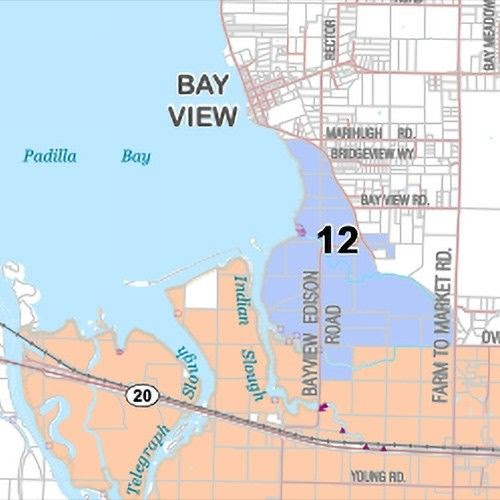
The tidegate at the center of the current controversy is not impressive. It is the tiny purple dot in the map above; “12” refers to Dike, Drainage and Irrigation District 12. I took a photo of it not quite sure if I knew what I was looking at.
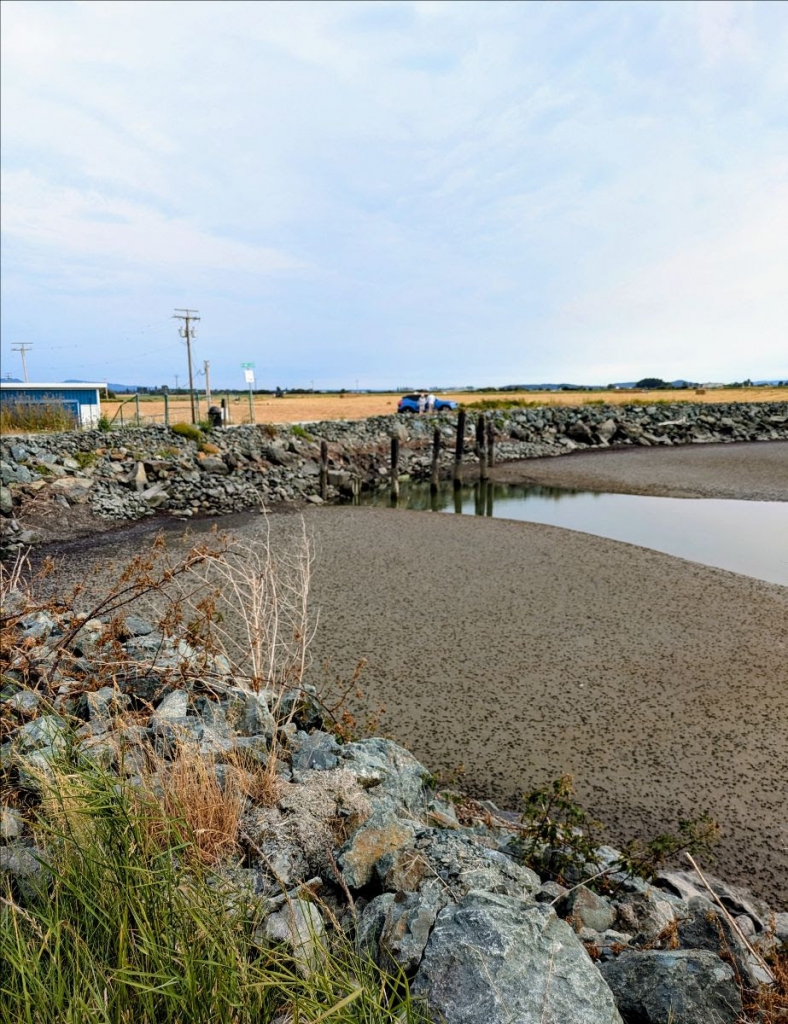
I believe the tide gate is at the water line below the blue car. You can barely see it.
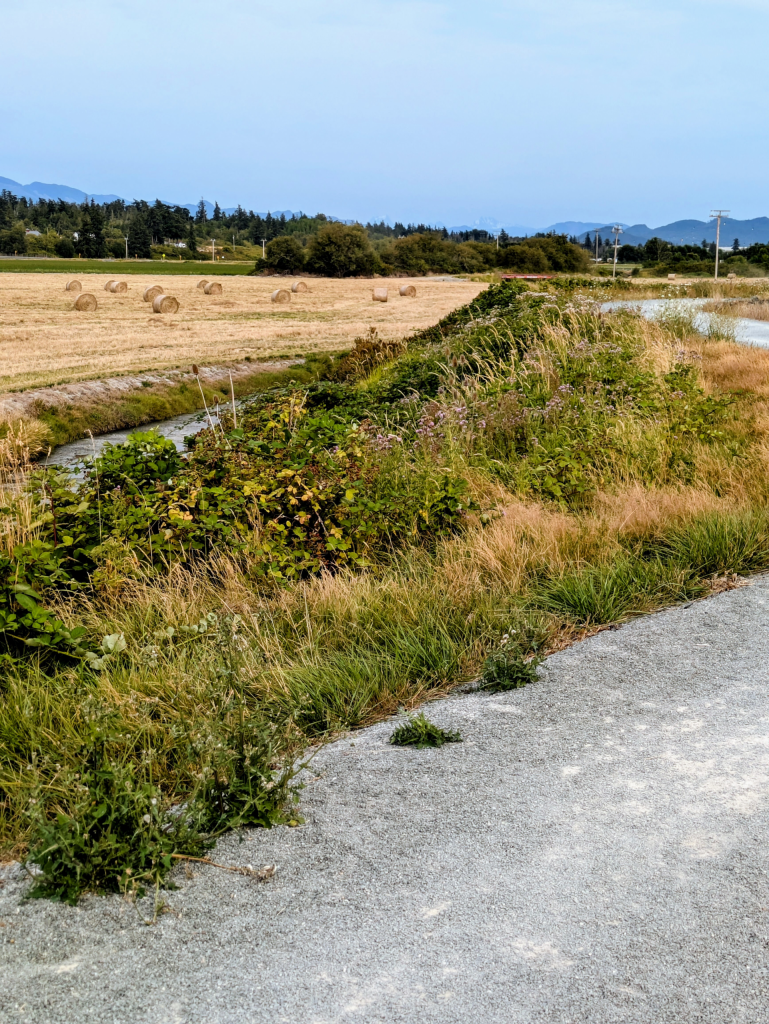
Why tide gates are important can be seen by the farm ground at the left. It lies below the level of Padilla Bay to the right of the path on top of the dike, and you can see a drain canal at the inside of the dike.
Jenna will us know next Thursday whether my guess about the tide gate is correct. Join us to find out. I have no pride about this one.
Don
14 August 2025
Have you recently driven up I-5 to Bellingham? Roundabout Mt. Vernon you may have glanced to your left and seen tulip fields, a dairy or two, or potato fields. You thought ‘that’s nice’ and you headed up the highway, maybe taking the scenic route up Chuckanut Drive along Salish Sea.
You were looking at about 60,000 acres of the state’s best farm ground, and at Puget Sound beyond which is held back by dikes, levees and tide gates.
What’s a tide gate? “The Skagit Delta tidegates have a simple purpose: to drain farmland when the tide goes out, then block incoming tides when they come lapping at the gate. “
And the tide gates are old. They need repair. This is the issue, and the rules have changed. What was once routine, no longer is. Salmon recovery complicates the issue. And salmon advocates introduce litigation into the routine.
Jenna Friebel heads up the Skagit Drainage and Irrigation District Consortium, a consortium that includes District 12 which is involved in the current litigation, leaving Jenna to coordinate the legal action.
Just to relieve Jenna to talk about the issues, I will let the State Auditor tell you about the Consortium:
The Skagit County Drainage and Irrigation District Consortium was formed in December 2018 to coordinate efforts countywide. Members include Skagit County Diking District No. 3, Skagit County Dike, Drainage and Irrigation Improvement District No. 5, Skagit County Drainage and Irrigation Improvement District No. 14, 15, 16, 17, 18, 19, Skagit County Consolidated Dike, Drainage, and Irrigation Improvement District No. 22, Skagit County Drainage and Irrigation District No. 22, Skagit County Dike and Drainage District No. 25, and Skagit County Dike, Drainage and Irrigation Improvement District No. 12. They are overseen by a five-member Executive Board and an Executive Director. Its main revenues are assessments charged to each of the creating drainage and irrigation districts. Revenues in 2021 and 2022 were $163,500 and $252,728, respectively.
Join Jenna and our team. Learn about a natural resource issue affecting farmers in the Skagit Valley. How are Skagit Delta tide gates like our Lower Snake River dams, and what can we learn?
Don
11 August 2025
The Ag and Rural Caucus approved support of the north counties (Pend Oreille, Stevens, Ferry, and Okanogan) in the amount of $500 to each county organization to use at the county’s discretion.
Don
8 August 2025
David Green, State Party Treasurer and Finance Committee co-chair, has seeded our conversation this evening with his notes below.
Take David’s initiative as an opportunity to develop your own thoughts and join the conversation this evening.
Don,
The state party’s Finance Committee has been charged with awarding funds to local party organizations who have submitted grant requests to the committee (the first round of submissions is due later this week, I believe.) Our grant-making process focuses on “party-building” activities (to avoid the issue you addressed with the PDC on supporting specific candidates or ballot initiatives.)
Rural initiative submissions are part of the targeted categories for which RFPs have been solicited by the Finance Committee. It is suggested that any single RFP be limited to a maximum of $2,000 funding request, although it is possible for local LPOs to “band together” for funding in excess of the $2,000 suggested limit.
A couple of thoughts for your internal conversation on Thursday:
- The Caucus could consider transferring its funds to the state party for inclusion in the 2025 grantmaking process, with the request that the funds target rural RFP submissions.
- I don’t know whether there’s any overlap between ARC membership and the membership of the Finance Committee, but if there is, an alternative approach would be for ARC to designate such a dual-role committee member as capable of “taking” one or more rural-focused RFP submissions out of the Finance Committee’s consideration and have that funding occur by ARC instead of the state party. This would mean there would be no need to have a separate RFP process — as the ARC funding could “cherry pick” any rural-focused RFP requests that are coming into the Finance Committee (in the near term, if not already received.)
- Other options are also potentially on the table — given the overlap in interest in funding rural-focused projects by the Finance Committee and ARC. I’m happy to entertain (with Finance Co-Chair Julie Johnson) any thoughts you might have.
- Finance Committee is scheduled to review the first round of RFP submissions a week from today, August 12.
Keep in mind that some LPO recipients may be “mini-reporting” filers with the PDC — and if so, have a maximum amount of $500 that they can receive from any single funding source (whether it be the state party, ARC, or an individual contributor.) The Finance Committee carefully reviews the PDC filing status of LPOs prior to its grantmaking approval process.
Isabella is the staff person coordinating the RFP process for the Finance Committee in case you might have any process questions for her. I’ve copied her and Finance Committee Co-Chair Julie Johnson on this message.
Dave
Don
7 August 2025
Better Practices
August Potpourri
6:30 pm Thursday 7 August
Marty Gilmore, ARC treasurer, reminds me that ARC has about $3,000 in the bank. The amount has accrued over a number of years when we had annual dues of $40 per county. It has accrued, too, because we have recorded no expenses, thanks(?) to COVID and our move to on-line meetings.
I sought PDC guidance to how we can use the money. We have a green light as long as we do not support specific candidates or ballot initiatives.
My thought is that we should invite LPO proposals for constructive use of the funds and award the money.
Your thoughts? Let’s discuss Thursday.
Don
05 August 2025
Ken Golling from LD 19 has a report and request.
Indivisible – what do you know? We can share.
https://us02web.zoom.us/j/86197176823?pwd=6BIWfzuGjNJvviW6YvgbeDeLHKF8FA.1
Policy Briefing

 6:30 pm Thursday 21 August
Jenna Friebel, ED, Skagit County Drainage and Irrigation Districts Consortium
Floodgates, Farmland, and Salmon - what are the facts?
 https://us02web.zoom.us/j/85907982157?pwd=MU4vV3E3VGZ5VU02dnhvZjg2b3hK.Zz09

Click link or Paste link into browser.
Our Better Practices roundtable is on the first Thursday of each month at 6:30 pm.. Use the link above for 2025.
Our Policy Series is on the third Thursday of each month at 6:30 pm. Use the link above for 2025.
Copyright © 2025 Ag and Rural Caucus, All rights reserved.
Ag and Rural Caucus of State Democratic Central Committee
Our mailing address is:
Ag and Rural Caucus
2921 Mud Creek Rd
Waitsburg, WA 99361